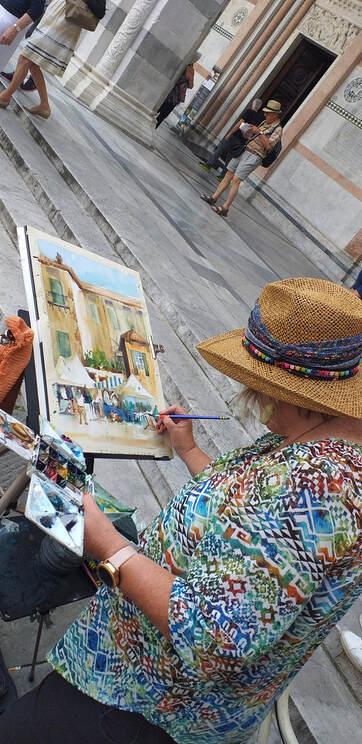
There’s nothing easy about painting watercolour en plein air but, for me, it is an exhilarating and fun experience.
My early attempts, however, were difficult and my paintings absolutely atrocious! It seemed to take me forever to get to grips with this new style of painting in the great outdoors. Without realising, I was faithfully following the 80/20 rule, 80% observation 20% drawing /painting. Later it dawned on me: this rule does not apply to painting watercolour en plein air - I was trying to follow a guideline for the constant situation of studio/observational drawing. When painting in the field, from the time you select your subject to your end-game, you have about 1-1.5 hours, 2 hours at most, to capture the subject before light and atmospheric conditions change too much. No mean feat but, if you practice, you will improve every time. Another element to consider is the subject. My first attempts at painting en plein air were with groups of artists who love painting landscapes. For me, it was a big problem. Although I love good quality landscape paintings, I’m not interested in painting them myself. I’m a city girl afterall, I’m attuned to light and shadows bouncing around architecture and the people who inhabit amazing spaces. Just think of Lisa Douglas (Eva Gabor) and you'll have hit your nail on the head! I often tell my students to slow their painting process down but in the case of painting watercolour en plein air, I’m going to contradict myself and tell you to speed up! Speed up so you catch the light and changing conditions, Remember, watercolour is a fast medium. Give yourself 5 minutes, and only 5 minutes, to take photos and sketch 1 or 2 value thumbnails and most importantly, take a mental snapshot. Make your memory work for you and, even if you think your result is "wrong", your work will be formed of the essence of your subject. Perfetto!! What a great excuse to go out and paint it again!! Your next work at the same scene will include different features and details and the next different again. My personal strategy is to map the subject onto my watercolour paper with a 5 minute sketch and then not refer to the actual scene again, even if I have to turn away from it. I am painting my interpretation of the scene not a photograph. Changing light and shadows become mighty confusing and create confusing paintings. Learn the tools you need to assist you:
x 
2 Comments
Process strategies every watercolour painter needs to know!!
Have fun!!
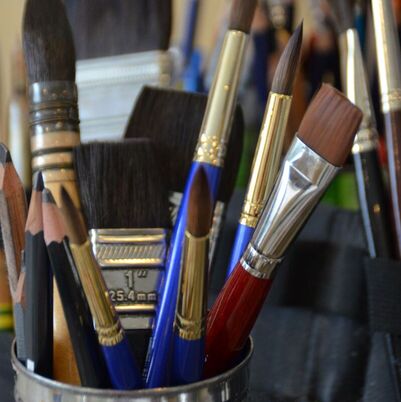
A new term starting and lots of new students, beginners and not-so beginners, so this is a good time to talk about how to care for your watercolour brushes.
Why? Because they're expensive - my first natural bristle brush cost $300 - I'd better look after it!! that was close to 25 years ago and it's still a great brush - because I look after it!!
Love them and USE them lots! Yes, you might wear them out or even better, your brush miles will make you want a better brush - fantastic!! ciao cari pittori!! 
|

AuthorPaintBox Tips, secrets, random thoughts, 
Poetry in watercolour is made in the freedom of the here and now. Amanda Brett Inspiration exists, but it has to find you working - Pablo Picasso 
There are no mistakes in watercolour, just some extra surprises!! Categories
All
What my readers and viewers have to say
Your emails are so informative! I must confess I've watched a couple of your demos from beginning to end, and it makes me want to watercolor!!! I've only ever painted with oil or acrylics and haven't know how to begin with WC. Your content is excellent!
Susan VN Hi Amanda
Thank you for your tips. They inspired me to practise and I realised I haven’t been loading the brush properly. I learnt about adding more paint, and not water, to washes. In today’s tips I like the idea of painting with purpose. Your tips are very helpful. I very much appreciate receiving them. Elizabeth Hi Amanda I enjoyed your post and generous tips. Looked up Dan Burt I begin to see that you can colour any subject to give it pizazz so long as the tone and form is correct Certainly adding value now to my attempts Thanks heaps Annie
Yes very wise words. Agree with not fussing and agree with comments about good quality paint. Well written and inspirational as always. Cheers Janet xxxx Archives
July 2023
Copyright © 2022 All images and text on Amanda's blog and website are the the legal property of Amanda Brett and may not be reproduced without express permission from Amanda Brett or her authorised agent. Thank you for respecting her art and the livelihood of all artists.
|